This transcript was generated from the episode audio and may contain minor errors.
[Music]
Music graduate makes spare change filling spare rooms. By the way, if that title sounds less than exciting, if you're like, he makes spare change. No, he actually makes millions of dollars. So maybe I should update that. But basically this self-taught coder in London long ago, builds a website to help housemates find each other.
And 15 years on, this project's been going for a while, but originally a side hustle, of course. It earns millions of dollars in profit and has hundreds of thousands of members. It expands to the US, et cetera. I'll tell you all about that in the story. My little comment or encouragement by way of preface is sometimes what you set out to make takes a turn for the better.
And you never would have had the new idea if you hadn't begun to pursue the first idea. So this happened to me when I first started the blog, The Art of Nonconformity. I thought I was gonna write about travel, and I did, in fact, write about travel and my journey to every country in the world. But as I began to connect with readers, I began to see, oh, they actually are connecting for all kinds of different reasons. It's not just about travel.
It's about truly living a remarkable unconventional life. So my journey took a turn for the better once I understood that. And today's story is similar in that way because, as I said, he's a music graduate. He makes some extra money filling spare rooms, but then it goes on to help hundreds of thousands of people. In some ways, it's an unlikely tech success story, but I really like and admire the hard work, persistence, and just kind of passion and heart that this guy puts into the project.
So I'm excited to share it with you after this quick shout out to our sponsor. Stay tuned. [Music]
It was the year 1999. The year that Prince predicted would be a great party and right before Y2K. Rupert Hunt had graduated from university with a music degree and moved to London.
His dream of starting a successful band hadn't quite worked out. So for a while, he stocked shelves at a supermarket. With the new millennium about to roll around, Rupert's aspirations moved from music to web development. He wanted to make more money, build a better life for himself and stop stocking shelves. Now he had no programming experience, but wasn't afraid of hard work.
So instead of taking a low level corporate job, he decided to intern for a local internet entrepreneur in his spare time. This guy ran a website and Rupert viewed it as an opportunity to gain some skills as a developer. He also thought it would be a good way to be exposed to new ideas. Now this plan worked and after a short time, Rupert landed a gig for a local agency. He continued in that role for a few years when the spare space in his mind began filling with a business idea.
He thought back about that experience moving to London, the difficulty he had had in finding a place to rent. With his new skills, he started building a website that listed properties for rent. After a few weeks of work, he launched intolondon.com for just that purpose. Now at the last minute, Rupert decided to bolt on a message board for people seeking housemates. Just in case anybody browsing the site was looking to share an apartment instead of renting their own.
Intolondon.com launched with little fanfare, didn't experience much growth or success. In fact, the rental classifieds area of the site didn't take off at all, but something unexpected happened. The housemate notice board that Rupert had tacked on at the last minute proved quite popular. In fact, it was the only area of the site that caught any use at all. Naturally, this gave him another idea.
Rather than slog away at building a rental property site, he should listen to what his users and the market was telling him. There was clearly a need for a platform that made finding a housemate simple. With nothing more than 5,000 pounds on a credit card, Rupert launched spareroom.co.uk, a flat sharing website for the entire United Kingdom. Through Google and word of mouth, the site started to gain traction. But it wasn't until a marketing stunt in 2004 that things really took off.
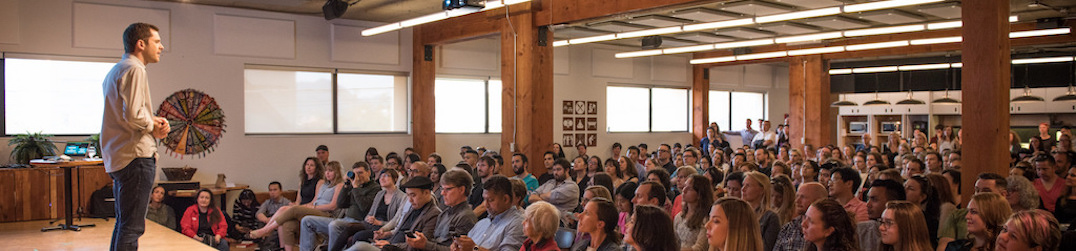
Rupert devised a real world event to promote his online destination. The event was speed flatmating, kind of like speed dating. But instead of looking for a love interest, attendees were looking for the ideal housemate. In an effort to drum up media interest, Rupert sent out a press release. Unfortunately, only one local newspaper turned up, but the show went on and everyone had a great time.
Now, as luck would have it, the Times of London, one of the UK's largest papers, saw the one local story and contacted Rupert directly, asking when the next event would be. Sensing an opportunity, Rupert decided to strike while the iron was hot. Although he had nothing planned, he told the Times there was another event happening on Thursday that same week. The second event, which he hastily put together, resulted in a highly positive write-up that went out across the nation. And that's when things exploded.
Shortly after he ran a third speed flatmating event, this one was attended by two TV crews, five radio stations, and nine journalists as well as lots of customers. From then on, the site continued to grow fast. And when it came to monetization, Rupert kept things basic. At first, he was charging visitors to the site a five pound lifetime membership fee. He was just so happy and surprised when people signed up.
He told some friends about his success, and one of those friends encouraged him to restrict the time limit on the membership to gain repeat transactions. What seemed so obvious after the fact had never occurred to Rupert before, and that was a big turning point in bringing in more revenue. Fast forward another few years, spareroom.co.uk had become the largest flat sharing site in the country. Being a first mover was a big advantage, but there were several other sites now in the space. So maintaining the lead wasn't easy.
Rupert puts the success down to having a true understanding and empathy with customers. He views spareroom as a modern day family business. That keeps the culture strong and also maintains a solid focus on providing real value to the members of the site. And it seems a lot of others agree because spareroom is a serious business with over $2 million in annual operating profit. With that success, Rupert decided to make the push from the UK into the US.
Since launching in New York, the site has helped match three quarters of a million flatmates already. He then went on to expand to several other cities, but guess what? One thing he didn't do though, he never went back to building the property rental site. Spareroom was the way. [Music]
Well, my friends, if you don't pursue one idea, you're never gonna get to whatever is waiting beyond that idea.
And so in this case, Rupert would have never had the idea to do spareroom, to focus entirely on flatmates. And then, you know, he had this first idea of charging five pounds, maybe about $8 or so for a lifetime membership. And that was a fantastic deal, but his friend comes along and says, like, why don't you make it, you know, an annual fee or monthly or whatever it was. It can still be a great deal, but people probably shouldn't get lifetime access. And then that of course had a huge difference in revenue.
So you never get to the ideas that are truly worthwhile, meaningful, maybe even life-changing like in this one without pursuing that first idea. So that's why I always encourage you to take action. You know, yesterday we talked about the aha moment. Somebody was like, I'm not sure what my aha idea is. Do you have any idea is what I suggest you think about.
What idea do you have at all? And who knows if it's gonna be the aha wonderful, you know, million dollar idea, but maybe it will lead you to something that is. Friends, check out spareroom.com. You can go to the US version or the UK version. It will kind of redirect you.
You can choose at the top. They have popular cities, including New York, Los Angeles, San Francisco, Miami, and of course London. It's a great resource. Continues to be a market leader all these years later. So congrats to Rupert.
Listeners, thank you for being out there as well. I appreciate you so much. I make the show for you every day. We are a community as well for more than 3,400 consecutive daily episodes. You can subscribe for free, follow for free, wherever you get your podcasts or just stop by the website to download or stream any of those 3,400 plus episodes, also for free.
My name is Chris Guillebeau. You are listening to Side Hustle School. [Music]